If you are currently evaluating your defensive toolkit, you might be looking for standard antivirus software for business to check a box. However, relying on the same basic protection model from five years ago means bringing a knife to a laser fight.
Cyberattacks have evolved dramatically. Today’s hackers don’t just blast obvious, easily detectable viruses into the wild. They use sophisticated, stealthy, and customized techniques designed specifically to slip past standard security guards.
To protect your business assets, customer data, and reputation, you need to understand the fundamental shift from traditional tools to Endpoint Detection and Response (EDR). Here is a high-level look at how modern threats work, and why legacy protection is no longer enough to stop them.
To understand why standard business security software falls short today, it helps to understand how it works. Think of traditional AV like an airport security guard holding a book of “Wanted” posters.
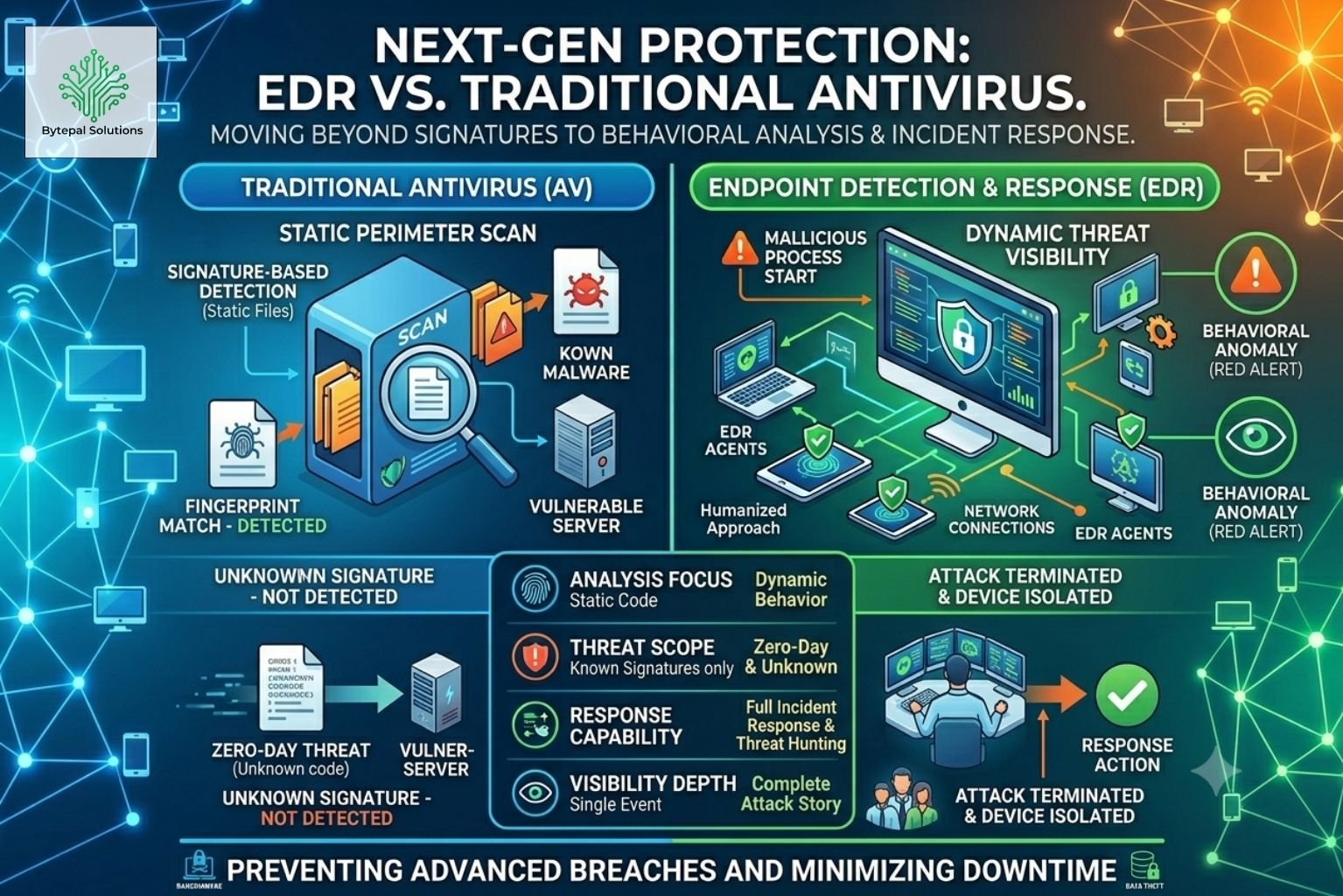
Traditional AV relies almost entirely on signature-based detection:
When a known malware strain is discovered in the wild, cybersecurity experts analyze its unique code and create a “signature”—essentially a digital fingerprint.
Your AV provider adds this fingerprint to a massive database.
When files enter your system, the AV scans them and checks them against this database. If it finds an exact match, it blocks the file.
This system works perfectly—if the threat is already known. But what happens if a hacker creates a brand-new piece of malware that has never been seen before?
This is called a zero-day threat. Because the malware is completely new, it has no digital fingerprint in the database. The traditional AV looks at the file, finds no match on its wanted list, and lets it straight through the front door.
Endpoint Detection and Response (EDR) doesn’t just look at what a file looks like; it watches what the file does.
If traditional AV is a security guard checking IDs against a list, EDR is a team of undercover, 24/7 private investigators monitoring the behavior of everyone inside the building. Even if a visitor has a valid ID, if they start trying to pick locks or break into the server room, the EDR team tackles them immediately.
EDR uses advanced behavioral analysis, machine learning, and continuous monitoring to spot anomalies. Here is how it stops modern threats:
Monitoring Behavior, Not Names: A zero-day malware file might look completely innocent on the surface. But once it runs, it might suddenly try to alter core system files, quietly encrypt data (the hallmark of ransomware), or harvest passwords. EDR spots this suspicious behavior instantly and stops it.
Isolating the Threat: If an employee accidentally clicks a malicious link and a device gets infected, a standard AV might alert you, but the malware can still spread across your network. EDR can automatically isolate that specific laptop from the rest of the business network, preventing a single infection from turning into a company-wide catastrophe.
Providing Forensic Context: EDR acts like a flight data recorder (a “black box”) for your computers. If a security event happens, EDR tells your IT team exactly how the attacker got in, what files they touched, and where they tried to go so you can patch the hole permanently.
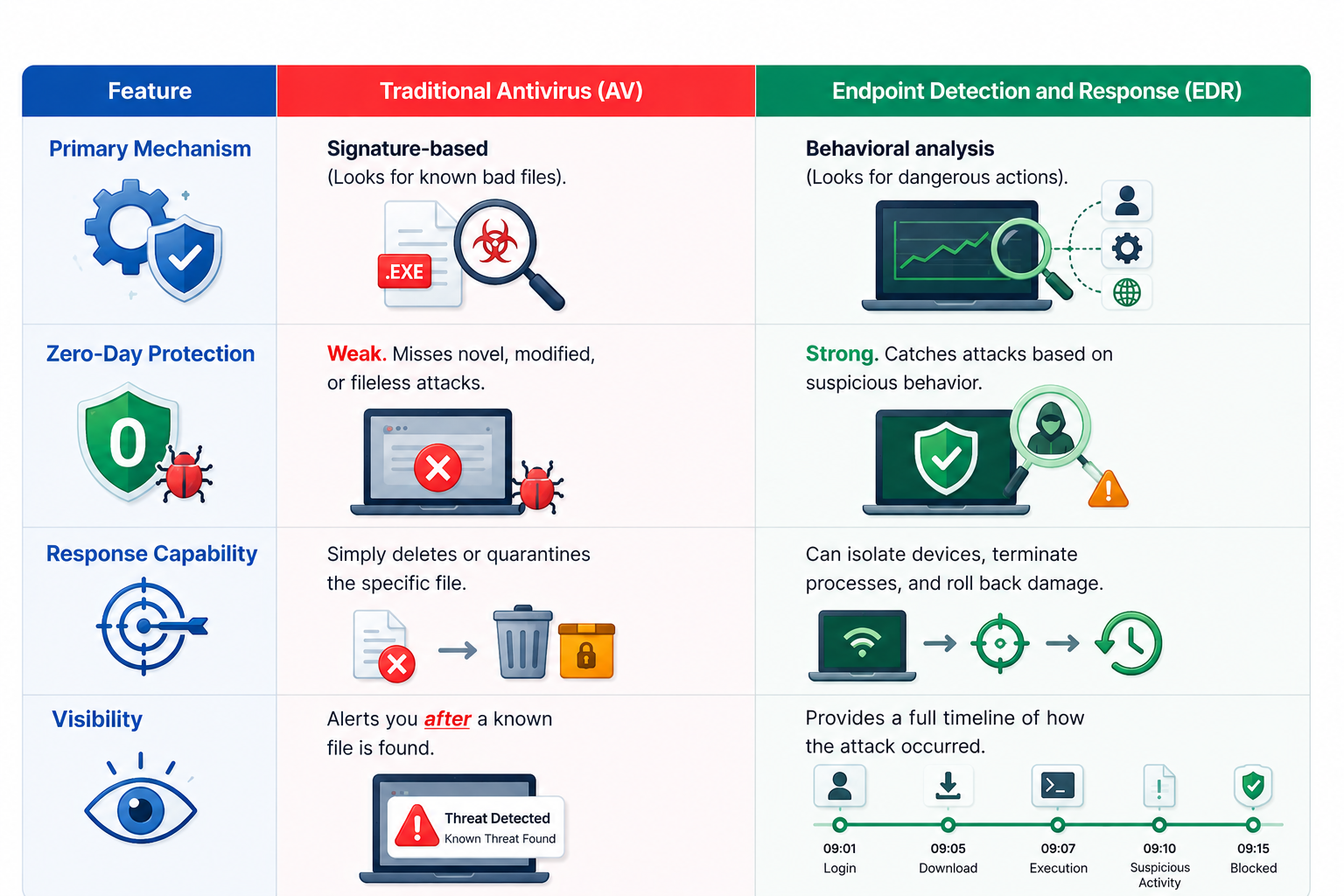
| Feature | Traditional Antivirus (AV) | Endpoint Detection and Response (EDR) |
| Primary Mechanism | Signature-based (Looks for known bad files). | Behavioral analysis (Looks for dangerous actions). |
| Zero-Day Protection | Weak. Misses novel, modified, or fileless attacks. | Strong. Catches attacks based on suspicious behavior. |
| Response Capability | Simply deletes or quarantines the specific file. | Can isolate devices, terminate processes, and roll back damage. |
| Visibility | Alerts you after a known file is found. | Provides a full timeline of how the attack occurred. |
The short answer? Upgrading to modern security software for companies is no longer optional.
In the modern threat landscape, relying solely on traditional AV is a massive business risk. Hackers know exactly how to bypass signature-based tools, often utilizing “fileless malware”—attacks that use legitimate, built-in system tools to execute malicious commands without ever downloading a traditional “virus” file.
While traditional AV still has a small place in filtering out basic, low-level junk code, EDR is the benchmark required to defend against ransomware, targeted phishing, and zero-day exploits. Upgrading your corporate security architecture isn’t just about buying better software; it’s about giving your business the resilience to survive an attack, keep your operations running, and protect your bottom line.
Complete protection for your digital life and identity.
Smart maintenance for your systems.
Smart websites for your digital presence and business growth.
Welcome Back 👋
Sign in to access your account and continue where you left off.
Welcome aboard 🚀
Create your account to access everything you need.