The Role of API Integrations in Enhancing Mobile App Scalability and User Experience (UX)
What is API Integration in Mobile App Development?
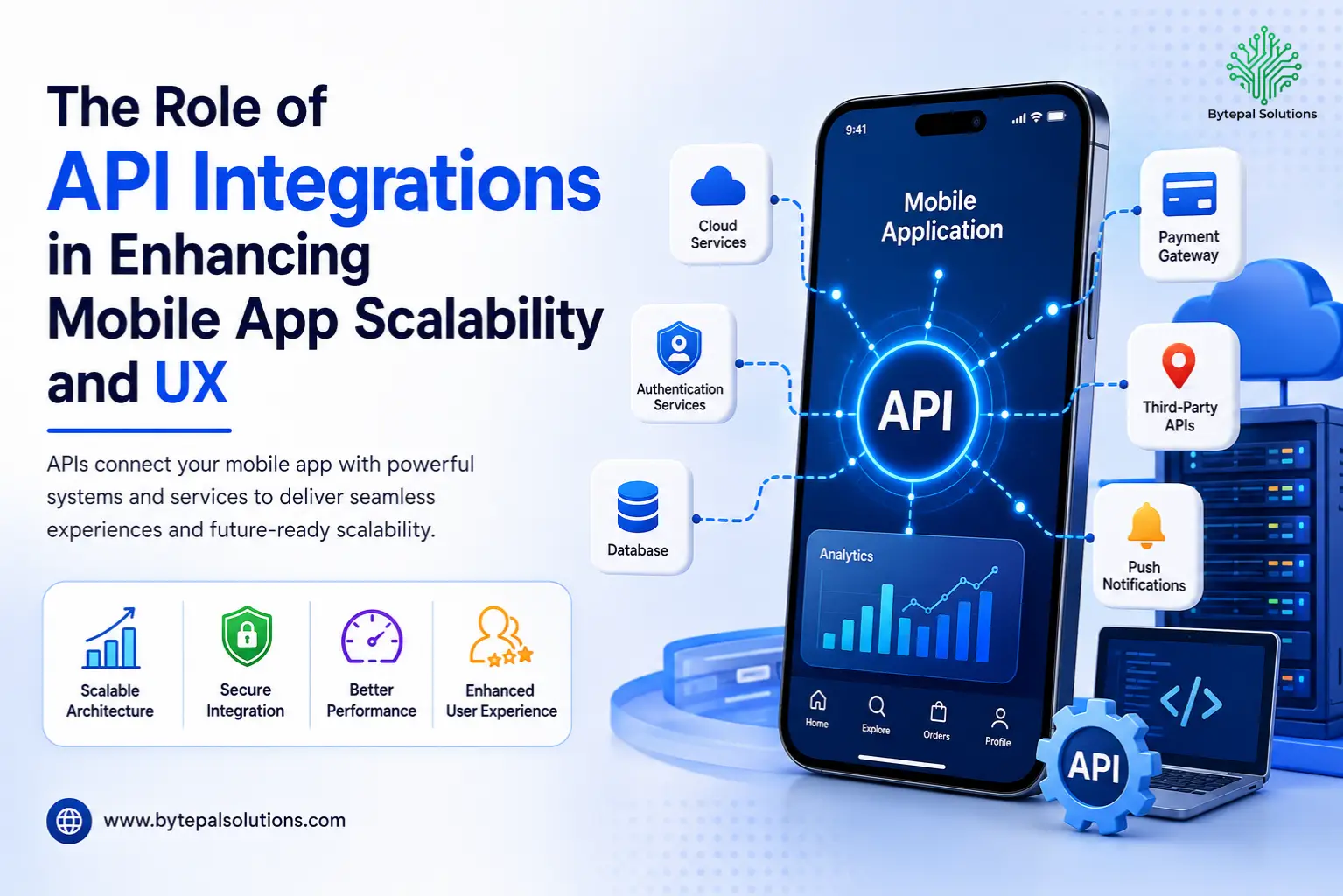
An Application Programming Interface (API) is a set of protocols that enables different software applications to communicate securely with one another.
Instead of directly accessing databases or backend systems, mobile applications exchange structured requests through APIs. These requests are processed by backend servers, which then return the required information to the application.
For example:
- Logging in with Google
- Processing online payments
- Displaying Google Maps
- Fetching product inventory
- Synchronizing customer information from CRM software
All of these functions rely on API integrations.
By using APIs, businesses can connect mobile applications with internal systems and third-party services without rebuilding existing infrastructure.
Why API Integration Matters for Modern Mobile Applications
Today’s businesses rely on multiple software platforms simultaneously.
These often include:
- Customer Relationship Management (CRM)
- Enterprise Resource Planning (ERP)
- Cloud storage
- Payment gateways
- SMS services
- Email platforms
- Analytics tools
- AI-powered services
API integration connects all these systems into one seamless mobile experience.
Without APIs, every new feature would require building an entirely new backend system, significantly increasing development time and operational costs.
As businesses continue to embrace digital transformation, API Integration in Mobile App Development has become a fundamental strategy for building connected, scalable, and intelligent applications. Whether you’re integrating payment gateways, CRM platforms, cloud services, or enterprise software, API Integration in Mobile App Development enables seamless communication between systems while improving operational efficiency and delivering a superior user experience.
How API Integration Improves Mobile App Scalability
One of the biggest advantages of API integration is scalability.
As your business grows, your application should be able to support:
- More users
- Higher transaction volumes
- New features
- Larger databases
- Multiple devices
- Global traffic
A robust API architecture makes this possible.
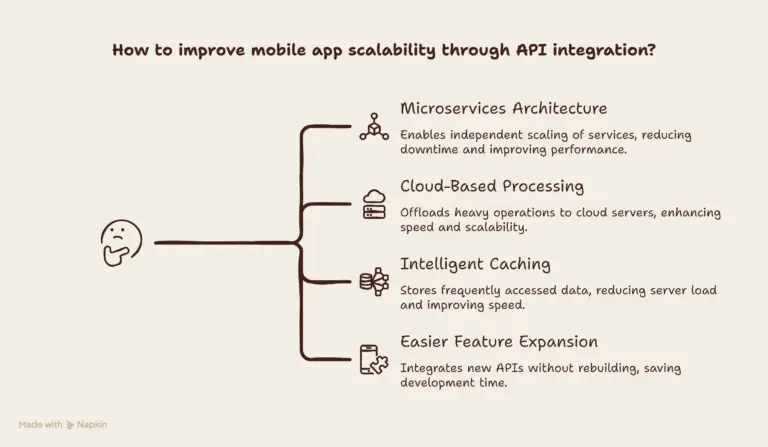
1. Microservices Architecture
Traditional applications often rely on monolithic architecture where every feature is connected within a single system.
If one component experiences heavy traffic, the entire application may slow down.
Modern mobile applications use microservices, where individual services operate independently.
For example:
- User Authentication API
- Payment API
- Notification API
- Product Catalog API
- Order Management API
Each service scales independently, improving overall application performance while reducing downtime.
2. Cloud-Based Processing
Mobile devices have limited processing power.
Instead of handling heavy operations locally, APIs send requests to cloud servers where complex processing occurs.
This approach offers several benefits:
- Faster app performance
- Lower battery consumption
- Reduced device storage usage
- Improved processing speed
- Better scalability during peak traffic
Cloud APIs also allow businesses to increase computing resources whenever demand grows.
3. Intelligent Caching
Repeated API requests increase server load.
Modern APIs implement caching mechanisms that temporarily store frequently accessed data such as:
- User profiles
- Product categories
- Images
- Settings
- Static content
This reduces unnecessary server communication while improving application speed.
Benefits include:
- Faster loading times
- Reduced server costs
- Lower bandwidth usage
- Better customer experience
4. Easier Feature Expansion
Businesses constantly add new services.
Examples include:
- AI chatbots
- Push notifications
- Loyalty programs
- Video consultations
- Digital wallets
- Appointment scheduling
With API-driven architecture, developers simply integrate new APIs instead of rebuilding the entire application.
This significantly reduces development time.
How API Integration Enhances User Experience (UX)
User experience goes beyond attractive design.
Customers expect applications to respond instantly and work reliably.
API integration directly contributes to a better UX in several ways.
Real-Time Data Synchronization
Users expect accurate information at all times.
APIs synchronize data instantly between:
- Mobile apps
- Websites
- Backend systems
- Cloud databases
Examples include:
- Delivery tracking
- Banking balances
- Healthcare records
- Inventory management
- Live order updates
Real-time synchronization builds customer trust.
Faster Login Experience
Modern authentication APIs simplify user access through:
- Google Login
- Apple Sign-In
- Microsoft Login
- Biometric authentication
- Multi-factor authentication (MFA)
These features reduce friction during onboarding while improving account security.
Seamless Payment Processing
Businesses can integrate secure payment gateways like:
- Stripe
- PayPal
- Razorpay
- Square
Customers enjoy:
- One-click payments
- Faster checkout
- Secure transactions
- Multiple payment options
This leads to higher conversion rates.
Offline Functionality
Poor internet connectivity should not interrupt business operations.
Modern API architecture supports:
- Local data storage
- Automatic synchronization
- Retry mechanisms
- Background uploads
Users can continue working even without internet access.
API Integration for Enterprise Mobile Applications
Many enterprises still rely on legacy systems developed years ago.
These include:
- ERP software
- CRM platforms
- HR systems
- Inventory software
- Accounting platforms
Replacing these systems is expensive.
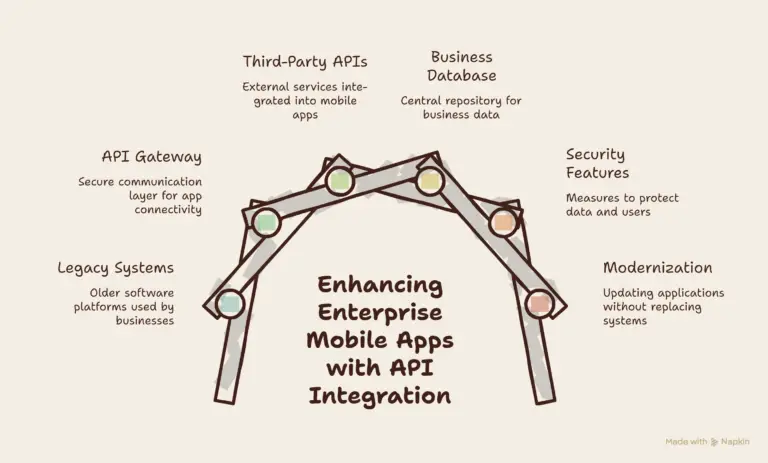
Instead, businesses use API gateways that connect modern mobile applications with existing infrastructure.
Typical API Architecture
Mobile Application
│
Secure HTTPS Requests
│
API Gateway
│
──────────────────────────
│ │
Third-Party APIs Legacy Systems
│ │
Payment APIs ERP Software
Maps API CRM Platform
SMS API HR Management
Cloud Storage Accounting System
│
Business Database
The API Gateway acts as a secure communication layer by:
- Authenticating requests
- Validating users
- Transforming data
- Monitoring traffic
- Applying security policies
This allows businesses to modernize applications without replacing existing enterprise software.
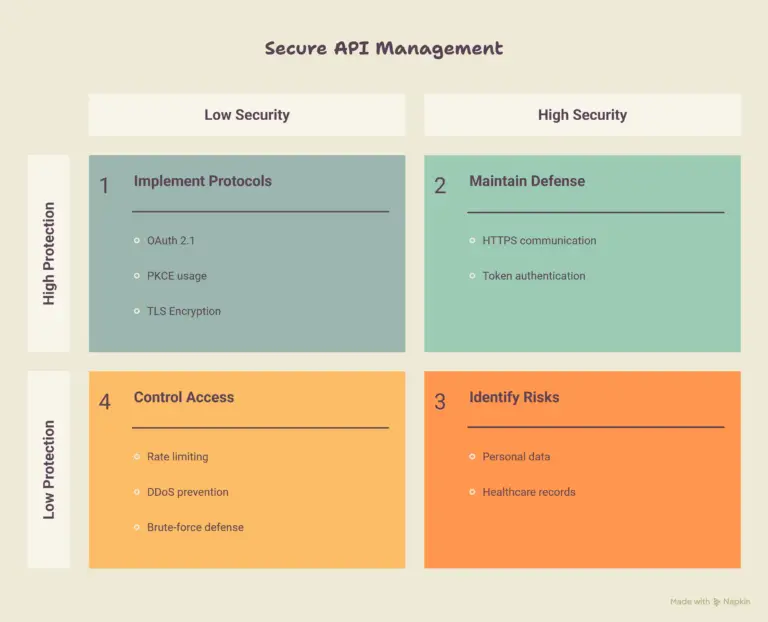
Essential API Security Best Practices
Security is one of the most important aspects of API integration in mobile app development.
Businesses handle sensitive customer information including:
- Personal data
- Payment information
- Healthcare records
- Business documents
Modern APIs protect this information through multiple security layers.
OAuth 2.1 Authentication
OAuth provides secure user authorization without exposing passwords.
Combined with PKCE (Proof Key for Code Exchange), it protects users from token interception attacks.
HTTPS & TLS Encryption
All API communication should be encrypted using TLS.
Encryption prevents hackers from reading intercepted data.
Rate Limiting
Rate limiting restricts the number of requests a user or device can send.
Benefits include:
- DDoS protection
- Reduced server overload
- Prevention of brute-force attacks
Token-Based Authentication
Instead of storing passwords, modern APIs use secure access tokens.
Tokens:
- Expire automatically
- Improve security
- Simplify authentication
- Reduce unauthorized access
Best Practices for Successful API Integration
To build scalable and secure mobile applications, businesses should:
- Design RESTful or GraphQL APIs
- Keep APIs well documented
- Use API versioning
- Optimize response sizes
- Implement caching
- Monitor API performance
- Secure endpoints with OAuth and JWT
- Test integrations regularly
- Use API gateways for centralized management
- Log and monitor API traffic
These practices improve both developer productivity and application reliability.
Business Benefits of API Integration
Companies investing in API integration gain several competitive advantages.
Faster Development
Developers reuse existing services instead of building everything from scratch.
Lower Development Costs
Third-party APIs reduce infrastructure and maintenance expenses.
Better Customer Experience
Fast applications improve customer satisfaction and retention.
Improved Business Agility
Organizations can quickly launch new services and respond to changing market demands.
Future Scalability
API-first architecture supports business growth without requiring complete system redesigns.
Why Choose Bytepal Solutions for API Integration and Mobile App Development?
At Bytepal Solutions, we build scalable, secure, and high-performance mobile applications powered by modern API architectures.
Investing in API Integration in Mobile App Development not only enhances application performance but also prepares businesses for future innovation. From supporting microservices and cloud infrastructure to enabling secure third-party integrations, API Integration in Mobile App Development helps organizations build reliable, scalable, and high-performing mobile applications that evolve with changing business requirements.
Conclusion
API integration is no longer an optional feature—it is the foundation of modern mobile applications.
A well-designed API architecture enables businesses to build faster, more secure, and highly scalable applications while delivering exceptional user experiences. From real-time synchronization and seamless payment processing to cloud scalability and enterprise system integration, APIs power nearly every digital interaction users rely on today.
Organizations that invest in API integration in mobile app development position themselves to adapt quickly to new technologies, expand their digital capabilities, and meet growing customer expectations without rebuilding their software ecosystem.
If you’re planning to build a future-ready mobile application, choosing the right API strategy today will ensure your app remains scalable, secure, and competitive for years to come.