


Enterprise-Grade Managed IT Support Services for Modern Business
More About IT annual maintenance (AMC)
Enterprise-Grade Managed IT Support Services for Modern Business
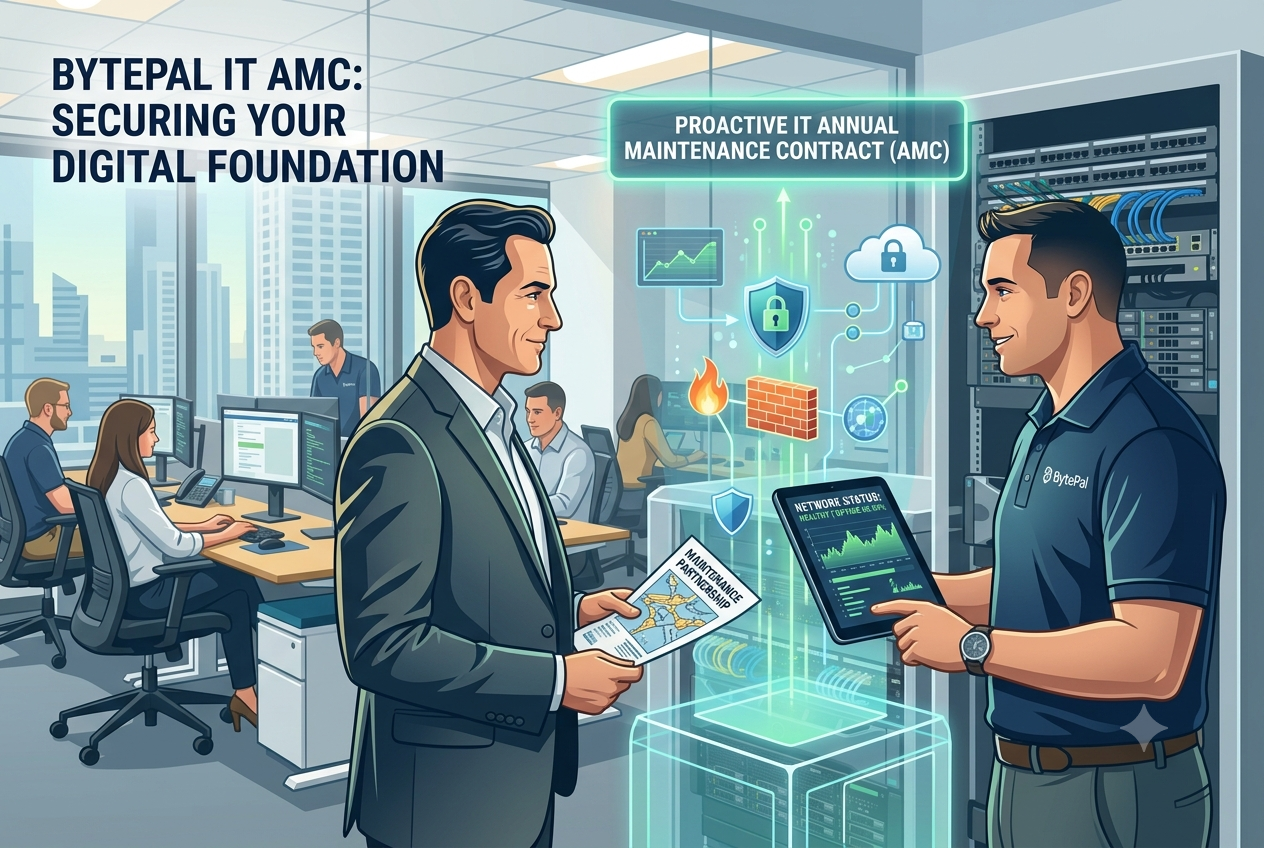
An IT annual maintenance contract is a formal, long-term service agreement where a professional IT partner assumes ongoing responsibility for the health, security, compliance, and optimization of your organization’s digital infrastructure for a fixed annual fee. Instead of scrambling during a crisis, your business secures continuous monitoring and maintenance designed to prevent downtime altogether.
Imagine a critical server crash or an internal network failure striking your office right during peak operational hours. As employee productivity grinds to a halt, the frantic search begins: calling local technicians, waiting for call-backs, and negotiating emergency hourly rates while your revenue slips away.
For many organizations, this unpredictable cycle is a normal part of business. It is known as the break-fix model—ignoring your technology until it breaks, then paying a premium to patch it together.
However, relying on reactive tech fixes is an expensive, high-risk strategy for modern businesses. To maintain operational continuity, forward-thinking enterprises are shifting toward a structured, proactive alternative: a dedicated IT annual maintenance contract.
An enterprise-grade IT annual maintenance contract goes far beyond simple emergency troubleshooting. It acts as a comprehensive shield for your entire digital ecosystem, typically covering four core operational pillars:
Hardware Lifecycle & Maintenance: Regular physical checkups, internal cleaning, performance diagnostics, and component optimization for servers, desktop workstations, routers, and essential storage systems. This prevents overheating and early equipment degradation.
Software & Security Upgrades: Routine, scheduled deployment of critical software patches, operating system updates, and system firmware upgrades across all corporate devices. This ensures your software stays stable and secure against emerging exploits.
Network & Infrastructure Audits: Continuous oversight of your internal local networks, firewalls, and Wi-Fi access points. Technicians proactively scan for configuration errors or bandwidth bottlenecks before they can disrupt day-to-day operations.
Priority Helpdesk Support: Backed by a strict Service Level Agreement (SLA)—a contractually guaranteed response timeline—an agreement ensures your company skips the queue. If a critical technical glitch occurs, certified engineers are dispatched immediately to resolve the issue.
When evaluating your options, organizations generally choose between two primary contract structures depending on their infrastructure age and risk tolerance:
This layout covers all routine labor, preventative maintenance, emergency troubleshooting, and the full cost of replacement spare parts or components if a device fails. It is best suited for organizations running mission-critical hardware where unpredictable repair costs could shatter quarterly budgets.
This structure covers all routine maintenance, technical labor, and priority support. However, any necessary spare parts or hardware components are billed separately at market cost. This is best for companies utilizing newer, under-warranty hardware where the risk of total component failure is minimal, but expert maintenance is required.
An IT annual maintenance contract is not an operational expense; it is a strategic asset that directly protects your company’s bottom line. Partnering with a dedicated corporate IT partner yields several distinct commercial advantages:
The break-fix model introduces extreme volatility to your cash flow. A single major server failure can result in an unexpected bill worth thousands of dollars. An IT annual maintenance contract consolidates your IT upkeep into a single, predictable annual or quarterly line item, allowing finance teams to allocate capital with precision.
According to infrastructure deployment data tracked by leading tech analysts like Gartner (this link provides an external authoritative resource), unplanned downtime costs businesses substantial revenue every hour in lost employee output and missed client opportunities. Because an IT annual maintenance contract prioritizes preventative maintenance, engineers often detect degrading hard drives, failing cooling fans, or network vulnerabilities silently in the background—resolving them before your team even notices a glitch.
Enterprise technology is a major capital investment. Just as regular, scheduled maintenance extends the operational life of corporate vehicles, routine optimization, firmware updates, and physical cleaning executed under a managed IT annual maintenance contract maximize the return on investment (ROI) of your workstations and server stacks.
Outdated software, unpatched operating systems, and misconfigured firewalls are the primary gateways for corporate data breaches. Security frameworks provided by documentation leaders like Microsoft Security emphasize that immediate patch distribution is mandatory for modern compliance. A contract ensures that critical security updates are never put on the back burner by busy internal staff. Your systems remain consistently defended against modern malware and cyber threats.
Enterprise-Grade Managed IT Support Services for Modern Business
Welcome Back 👋
Sign in to access your account and continue where you left off.
Welcome aboard 🚀
Create your account to access everything you need.