


Modern Web & App Development Requires an Outcome-Driven Strategy
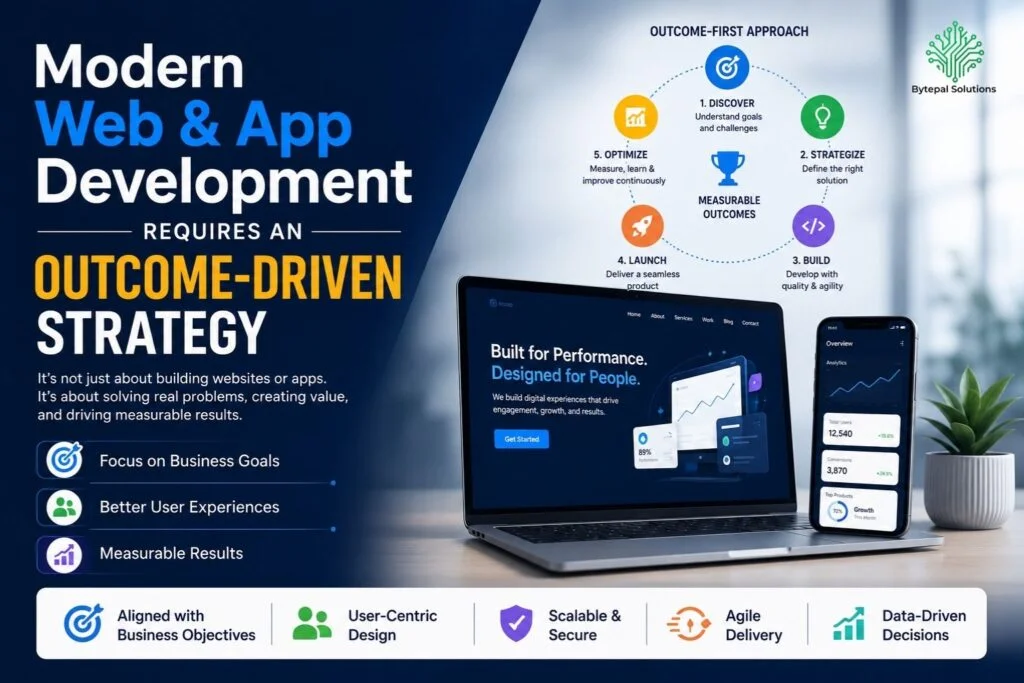
For years, enterprise digital products followed a familiar, linear lifecycle. A business would identify a need, hire an engineering team to write custom code for months, and launch a monolithic application. Then came the endless cycle of expensive maintenance, rigid software upgrades, and mounting technical debt.
In today’s fast-moving enterprise environment, that traditional model is a financial bottleneck.
Modern web and mobile applications are no longer just software products; they are the core engines driving business revenue, operational efficiency, and customer retention. For executive leadership, the priority has shifted from simply launching a platform to engineering long-term ROI.
To stay competitive, forward-thinking organizations are abandoning rigid software architectures in favor of Outcome-Driven Development and Composable Systems.
Shifting from Feature-First to Outcome-Driven Engineering
The most common point of failure in complex software projects isn’t the code itself—it is a lack of alignment with measurable business outcomes. Teams frequently fall into the trap of prioritizing features over functionality, building complex components before validating their economic or operational utility.
An outcome-driven strategy reverses this methodology by anchoring every technical decision to explicit corporate Key Performance Indicators (KPIs).
Technical Choices Driven by Business Impact
Enterprise Objective | Technical Execution Strategy | Core Metric Impact |
Accelerate Time-to-Market | Cross-platform consolidation utilizing unified frameworks like Flutter or React Native instead of separate iOS and Android native silos. | 30-40% reduction in upfront engineering hours; simultaneous multi-platform release parity. |
Optimize System Performance | Migrating legacy frontend infrastructure to edge-computed environments and utilizing performance-first compilers. | Sub-second page loads, stabilized Core Web Vitals (LCP/INP), and direct optimization of organic search visibility. |
Lower Customer Support Costs | Designing predictive user interfaces (UI) and integrating contextual workflow automation directly into the client dashboard. | Drastic reduction in customer onboarding duration and a drop in low-tier support ticket creation. |
The Power of Composable and API-First Architecture
Monolithic web and mobile applications—where the user interface, backend logic, and database are permanently bound together—are structurally brittle. When one component requires an update or experiences a traffic spike, the entire system faces downtime risks.
To build a resilient digital presence, enterprises are moving toward Composable Architecture.