


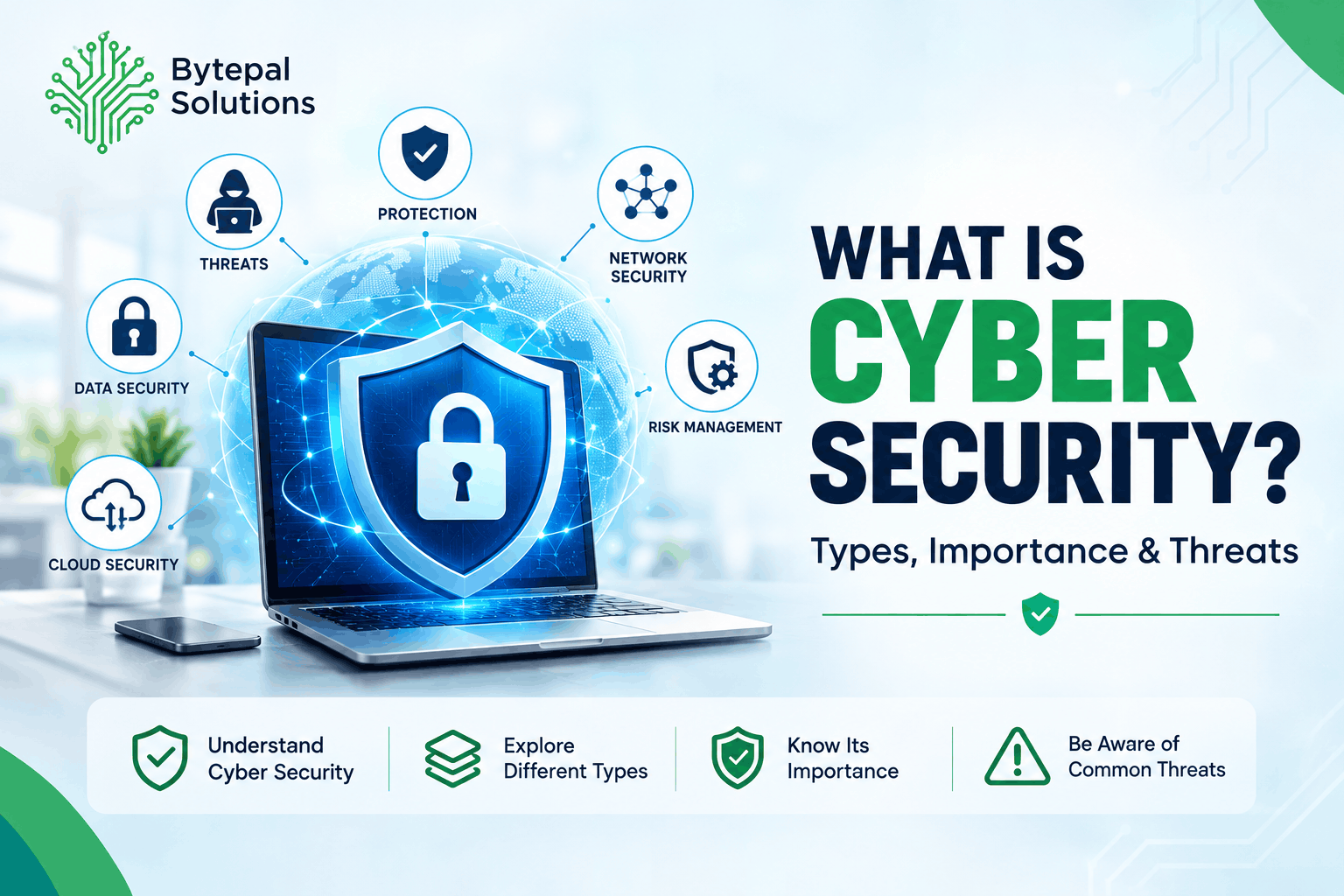
What is Cyber Security? Types, Importance & Threats October 14, 2026 Riya Khare Cybersecurity Cyber security is the practice of protecting computers, servers, mobile devices, networks, and data from unauthorized access, attacks, damage, or theft. It combines technology, processes, and people-driven practices to defend digital systems against an ever-growing range of threats, from malware and phishing to large-scale ransomware attacks. As businesses, governments, and individuals rely more heavily on digital infrastructure, cyber security has become essential for protecting sensitive information, maintaining trust, and ensuring operations run smoothly. This guide breaks down what cyber security is, the main types of cyber security, why it matters, and the most common threats you need to watch out for. What is Cyber Security? Cyber security refers to the collection of tools, technologies, policies, and practices designed to protect digital systems, networks, and data from malicious attacks or unauthorized access. It covers everything from securing a single laptop to protecting the massive infrastructure that powers global banking systems. At its core, cyber security aims to achieve three main goals, often referred to as the CIA Triad: The CIA Triad Explained Confidentiality Ensuring that sensitive information is accessible only to authorized individuals, preventing data leaks or unauthorized viewing. Integrity Making sure data remains accurate, consistent, and unaltered unless changed by an authorized process. Availability Guaranteeing that systems, applications, and data are accessible to authorized users whenever needed, without disruption. Together, these three principles guide how organizations design and implement their security strategies. Types of Cyber Security Cyber security isn’t a single discipline it’s a broad field made up of several specialized areas that work together to create a strong defense. 1. Network Security Network security focuses on protecting the integrity and usability of an organization’s network and data. It involves firewalls, intrusion detection systems, and secure network architecture to prevent unauthorized access. Common Network Security Tools Firewalls Virtual Private Networks (VPNs) Intrusion Detection and Prevention Systems (IDPS) 2. Application Security Application security involves keeping software and devices free of threats by identifying and fixing vulnerabilities during development and after deployment. Key Practices in Application Security Secure coding practices Regular vulnerability testing Patch management 3. Information Security Information security (InfoSec) protects the integrity and privacy of data, both in storage and in transit. It ensures data is not tampered with or accessed by unauthorized parties. 4. Cloud Security As more businesses move to cloud platforms, cloud security has become critical. It focuses on protecting data, applications, and infrastructure hosted on cloud services from breaches and misconfigurations. 5. Endpoint Security Endpoint security protects individual devices laptops, smartphones, tablets that connect to a network, since each device can be a potential entry point for attackers. 6. Identity and Access Management (IAM) IAM ensures that only authorized users have access to specific systems or data, using tools like multi-factor authentication (MFA) and role-based access controls. 7. Operational Security Operational security involves the processes and decisions for handling and protecting data assets, including permissions and procedures for storing and sharing information. 8. Disaster Recovery and Business Continuity This type of security planning ensures an organization can quickly recover data and resume operations after a cyberattack, natural disaster, or other disruptive event. Why is Cyber Security Important? Cyber security is no longer optional it’s a fundamental requirement for individuals, businesses, and governments alike. Protecting Sensitive Data Organizations handle vast amounts of sensitive data, including customer information, financial records, and intellectual property. A single breach can expose this data, leading to severe consequences. Preventing Financial Loss Cyberattacks can be extremely costly, resulting in direct financial theft, ransom payments, legal penalties, and lost business opportunities. Maintaining Business Reputation A data breach can severely damage customer trust and brand reputation, often causing long-term harm that’s difficult to repair. Ensuring Regulatory Compliance Many industries are subject to strict data protection regulations. Strong cyber security practices help organizations avoid fines and stay compliant with laws like GDPR, HIPAA, and others. Supporting Critical Infrastructure Cyber security also protects essential services like power grids, healthcare systems, and financial institutions, where a successful attack could have widespread real-world consequences. Common Cyber Security Threats Understanding common threats is the first step toward defending against them. 1. Malware Malware is malicious software designed to damage, disrupt, or gain unauthorized access to systems. Types of Malware Viruses – Attach themselves to legitimate files and spread when executed Worms – Self-replicate and spread across networks without user action Trojans – Disguise themselves as legitimate software to trick users Spyware – Secretly monitors and collects user information 2. Ransomware Ransomware encrypts a victim’s files or systems, with attackers demanding payment in exchange for restoring access. It’s one of the most financially damaging threats facing organizations today. 3. Phishing Phishing attacks use deceptive emails, messages, or websites to trick users into revealing sensitive information like passwords or credit card numbers. Common Phishing Techniques Spear phishing (targeted attacks on specific individuals) Whaling (targeting high-level executives) Smishing (phishing via SMS text messages) 4. Denial-of-Service (DoS) Attacks DoS and Distributed Denial-of-Service (DDoS) attacks flood a system or network with traffic, overwhelming it and making it unavailable to legitimate users. 5. Man-in-the-Middle (MitM) Attacks In these attacks, cybercriminals intercept communication between two parties to steal data or inject malicious content without either party knowing. 6. SQL Injection Attackers insert malicious code into a database query, allowing them to view, modify, or delete data they shouldn’t have access to. 7. Insider Threats Not all threats come from outside an organization. Insider threats involve employees or contractors who misuse their access, either intentionally or accidentally, to cause harm. 8. Zero-Day Exploits These attacks target software vulnerabilities that are unknown to the vendor, meaning there’s no patch or fix available at the time of the attack. How to Protect Against Cyber Threats Best Practices for Individuals Use strong, unique passwords and enable multi-factor authentication Keep software and devices updated regularly Avoid clicking suspicious links or downloading unknown attachments Use reputable antivirus and anti-malware software Best Practices for Organizations Conduct regular security audits
What is an IT Annual Maintenance Contract (AMC), and Does Your Business Need One?
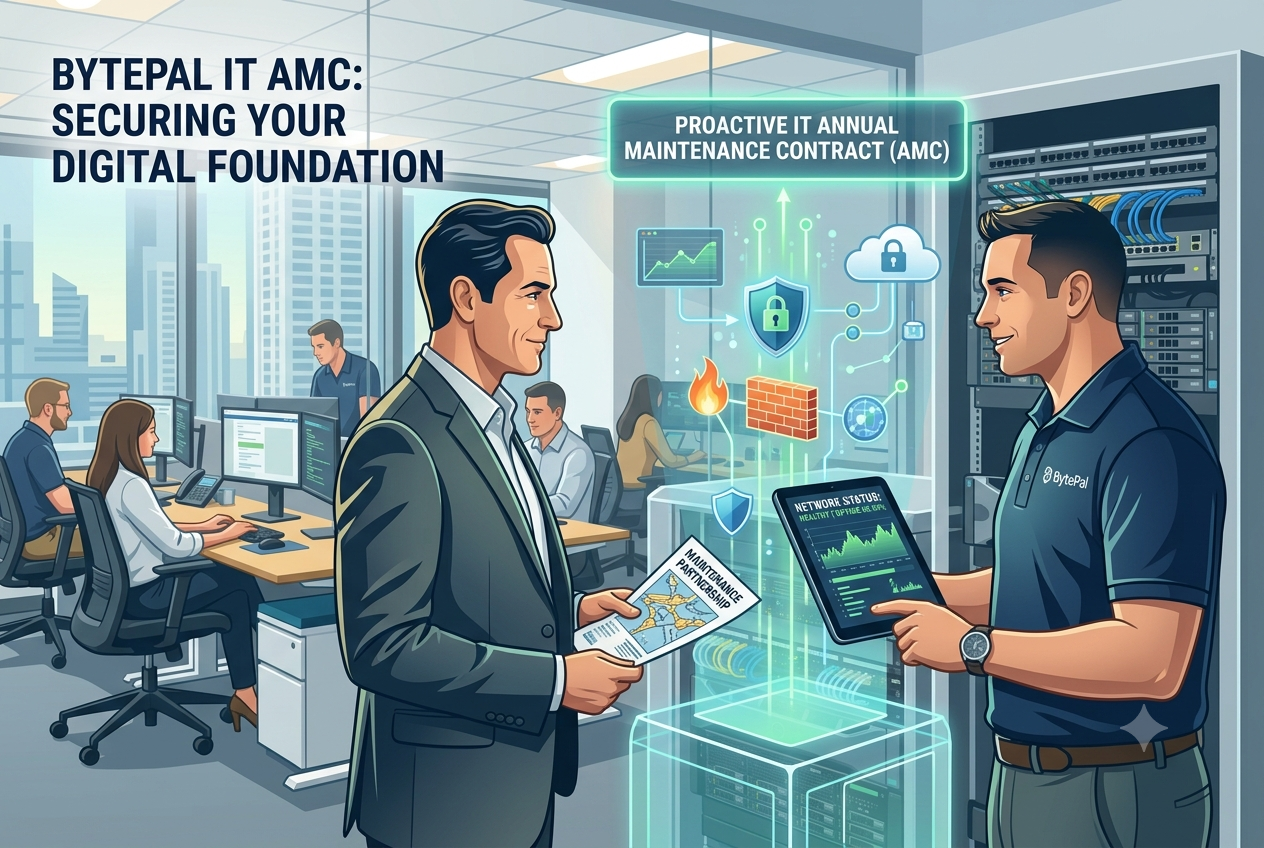
October 9, 2026 Riya Khare Antivirus An IT annual maintenance contract is a formal, long-term service agreement where a professional IT partner assumes ongoing responsibility for the health, security, compliance, and optimization of your organization’s digital infrastructure for a fixed annual fee. Instead of scrambling during a crisis, your business secures continuous monitoring and maintenance designed to prevent downtime altogether. Imagine a critical server crash or an internal network failure striking your office right during peak operational hours. As employee productivity grinds to a halt, the frantic search begins: calling local technicians, waiting for call-backs, and negotiating emergency hourly rates while your revenue slips away. For many organizations, this unpredictable cycle is a normal part of business. It is known as the break-fix model—ignoring your technology until it breaks, then paying a premium to patch it together. However, relying on reactive tech fixes is an expensive, high-risk strategy for modern businesses. To maintain operational continuity, forward-thinking enterprises are shifting toward a structured, proactive alternative: a dedicated IT annual maintenance contract. Deconstructing the IT Annual Maintenance Contract: What is Actually Covered? An enterprise-grade IT annual maintenance contract goes far beyond simple emergency troubleshooting. It acts as a comprehensive shield for your entire digital ecosystem, typically covering four core operational pillars: Hardware Lifecycle & Maintenance: Regular physical checkups, internal cleaning, performance diagnostics, and component optimization for servers, desktop workstations, routers, and essential storage systems. This prevents overheating and early equipment degradation. Software & Security Upgrades: Routine, scheduled deployment of critical software patches, operating system updates, and system firmware upgrades across all corporate devices. This ensures your software stays stable and secure against emerging exploits. Network & Infrastructure Audits: Continuous oversight of your internal local networks, firewalls, and Wi-Fi access points. Technicians proactively scan for configuration errors or bandwidth bottlenecks before they can disrupt day-to-day operations. Priority Helpdesk Support: Backed by a strict Service Level Agreement (SLA)—a contractually guaranteed response timeline—an agreement ensures your company skips the queue. If a critical technical glitch occurs, certified engineers are dispatched immediately to resolve the issue. Comprehensive vs. Non-Comprehensive IT Annual Maintenance Contract Agreements When evaluating your options, organizations generally choose between two primary contract structures depending on their infrastructure age and risk tolerance: Comprehensive IT Annual Maintenance Contract This layout covers all routine labor, preventative maintenance, emergency troubleshooting, and the full cost of replacement spare parts or components if a device fails. It is best suited for organizations running mission-critical hardware where unpredictable repair costs could shatter quarterly budgets. Non-Comprehensive IT Annual Maintenance Contract This structure covers all routine maintenance, technical labor, and priority support. However, any necessary spare parts or hardware components are billed separately at market cost. This is best for companies utilizing newer, under-warranty hardware where the risk of total component failure is minimal, but expert maintenance is required. The Bottom-Line Benefits: Why Growing Businesses Invest in an IT AMC An IT annual maintenance contract is not an operational expense; it is a strategic asset that directly protects your company’s bottom line. Partnering with a dedicated corporate IT partner yields several distinct commercial advantages: 1. Predictable Operational Expenditure (OpEx) The break-fix model introduces extreme volatility to your cash flow. A single major server failure can result in an unexpected bill worth thousands of dollars. An IT annual maintenance contract consolidates your IT upkeep into a single, predictable annual or quarterly line item, allowing finance teams to allocate capital with precision. 2. Drastic Reduction in System Downtime According to infrastructure deployment data tracked by leading tech analysts like Gartner (this link provides an external authoritative resource), unplanned downtime costs businesses substantial revenue every hour in lost employee output and missed client opportunities. Because an IT annual maintenance contract prioritizes preventative maintenance, engineers often detect degrading hard drives, failing cooling fans, or network vulnerabilities silently in the background—resolving them before your team even notices a glitch. 3. Extended Hardware Lifespan Enterprise technology is a major capital investment. Just as regular, scheduled maintenance extends the operational life of corporate vehicles, routine optimization, firmware updates, and physical cleaning executed under a managed IT annual maintenance contract maximize the return on investment (ROI) of your workstations and server stacks. 4. Stronger Cybersecurity Posture Outdated software, unpatched operating systems, and misconfigured firewalls are the primary gateways for corporate data breaches. Security frameworks provided by documentation leaders like Microsoft Security emphasize that immediate patch distribution is mandatory for modern compliance. A contract ensures that critical security updates are never put on the back burner by busy internal staff. Your systems remain consistently defended against modern malware and cyber threats.
NGAV: What is Next-Generation Antivirus and Do You Need It!
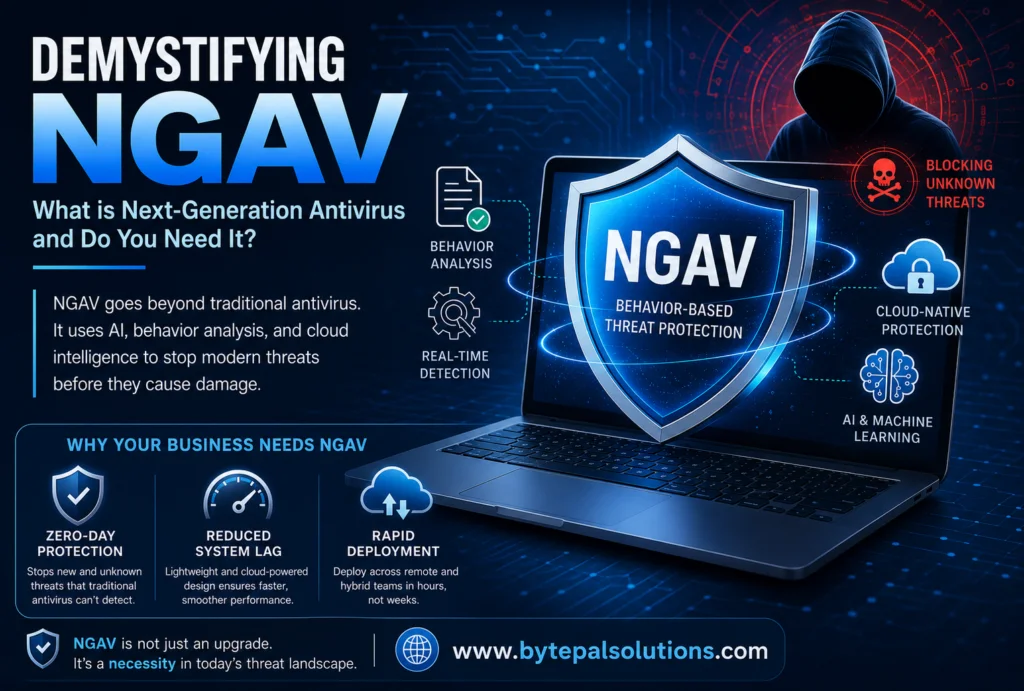
October 9, 2026 Riya Khare Antivirus The Mechanics of Signatures Think of standard antivirus software as a security guard at an office building checkpoint holding a book of “Wanted” posters. When a new malware variant is discovered somewhere in the world, cybersecurity researchers isolate its unique underlying code. They generate a specific digital fingerprint for that code, known as a signature. This signature is added to a massive, centralized database shared with your security software. When a file enters your system, the scanner checks it against this database. If it finds an exact match, the file is flagged and quarantined. The Fatal Vulnerability: The Zero-Day Attack While highly effective at filtering out known, low-level script junk, this database-driven model has a massive architectural flaw: it requires a victim to exist before a defense can be created. If a hacker writes a brand-new piece of malicious code—or subtly modifies an existing one so its digital fingerprint changes—the database has no record of it. This is known as a zero-day threat. When traditional software scans a zero-day file, it finds no matching signature on its wanted list, shrugs its shoulders, and allows the file straight into your corporate network. Enter the New Generation Antivirus (NGAV) As threat actors grew more sophisticated, the cybersecurity industry had to completely re-engineer its approach to defense. The result was the development of New Generation Antivirus. Instead of focusing on what a file looks like (its signature), a New Generation Antivirus focuses entirely on what a file is trying to do (its behavior). It shifts the defensive strategy from a passive look-up system to an active, real-time investigation. [Traditional AV] —> Checks File Fingerprint —> Match Found? No —> ALLOW RUN [Modern NGAV] —> Monitors File Execution —> Actions Taken? —> BLOCK IF MALICIOUS Side-by-Side: Legacy vs. Next-Gen Protection Feature Legacy Antivirus Software New Generation Antivirus (NGAV) Core Detection Method Database lookups (Signature-based). Intent & Activity (Behavioral analysis). Unknown Threat Response Weak. Relies on post-breach patches. Strong. Stops zero-day variants pre-execution. Handling Fileless Attacks Completely blind to them. Highly effective. Monitors system process anomalies. System Performance Impact High. Heavy local scans cause lag. Low. Cloud-optimized and lightweight. The Sophisticated Threat: Fileless Malware One of the most compelling arguments for migrating to a New Generation Antivirus framework is the rise of fileless malware. Modern attackers frequently avoid downloading standard malicious files altogether. Instead, they use a tactic called “Living off the Land.” They hijack trusted, legitimate administrative tools already built into your operating system (such as Windows PowerShell or Command Prompt) to execute malicious scripts directly in the computer’s temporary memory (RAM). Because no files are downloaded, traditional signature-based tools see absolutely nothing wrong. The software looks at PowerShell, recognizes it as a trusted application, and ignores the activity. An NGAV system, however, monitors the commands being run inside PowerShell. If it spots an administrative tool suddenly attempting to scrape passwords from memory or quietly encrypt data blocks, it recognizes the behavioral anomaly and cuts off the access immediately. Does Your Business Need to Upgrade? If your organization is still operating on a standard security model, you are exposed to substantial operational, financial, and reputational risk. Relying on legacy definitions to stop modern ransomware, data exfiltration, and supply chain attacks is a gamble that rarely pays off. Upgrading your endpoint infrastructure to a modern platform gives your business three critical advantages: True Ransomware Prevention: Ransomware moves with terrifying speed. NGAV platforms can spot the exact moment an unauthorized encryption process begins, halt it, and prevent a minor incident from becoming an operational shutdown. Seamless Remote Management: In a hybrid or remote work environment, keeping tabs on corporate laptops is incredibly difficult. Cloud-managed systems allow your IT lead to deploy updates, monitor alerts, and enforce security policies globally, regardless of where an employee logs in. Preserved Operational Continuity: Cyberattacks don’t just cost money in terms of recovery; the resulting downtime can stall your revenue for days or weeks. Proactive, automated containment keeps your business running smoothly without disruption.
EDR vs. Traditional Antivirus: What Your Business Needs to Prevent Modern Cyber Threats
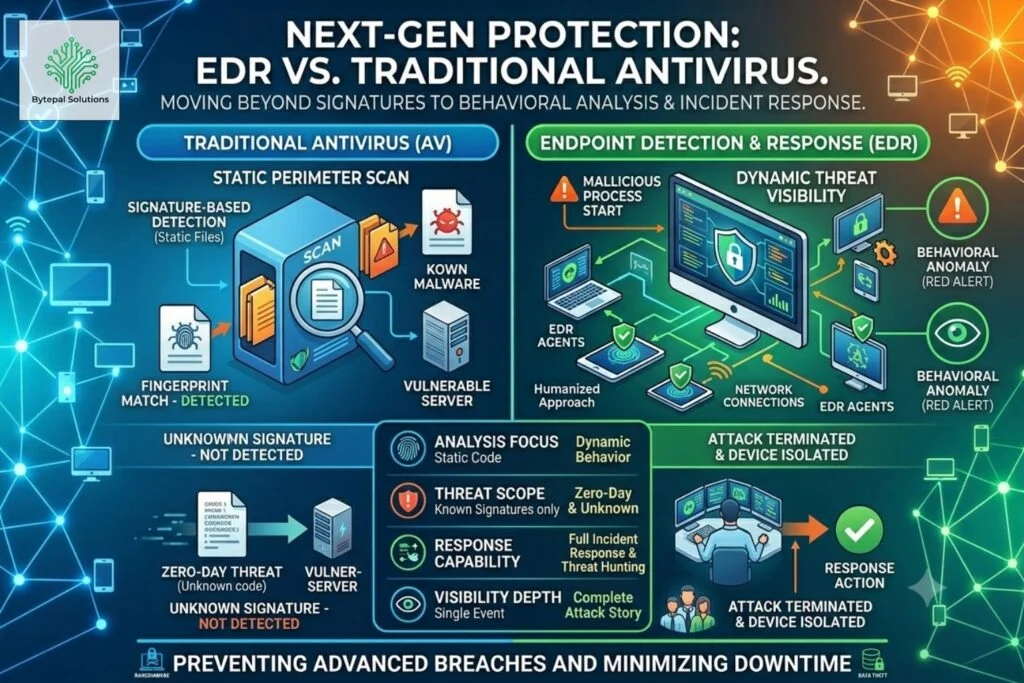
October 9, 2026 Riya Khare Antivirus If you are currently evaluating your defensive toolkit, you might be looking for standard antivirus software for business to check a box. However, relying on the same basic protection model from five years ago means bringing a knife to a laser fight. Cyberattacks have evolved dramatically. Today’s hackers don’t just blast obvious, easily detectable viruses into the wild. They use sophisticated, stealthy, and customized techniques designed specifically to slip past standard security guards. To protect your business assets, customer data, and reputation, you need to understand the fundamental shift from traditional tools to Endpoint Detection and Response (EDR). Here is a high-level look at how modern threats work, and why legacy protection is no longer enough to stop them. The Limitations of Traditional Antivirus (AV) To understand why standard business security software falls short today, it helps to understand how it works. Think of traditional AV like an airport security guard holding a book of “Wanted” posters. Traditional AV relies almost entirely on signature-based detection: When a known malware strain is discovered in the wild, cybersecurity experts analyze its unique code and create a “signature”—essentially a digital fingerprint. Your AV provider adds this fingerprint to a massive database. When files enter your system, the AV scans them and checks them against this database. If it finds an exact match, it blocks the file. The Fatal Flaw: The Zero-Day Exploit This system works perfectly—if the threat is already known. But what happens if a hacker creates a brand-new piece of malware that has never been seen before? This is called a zero-day threat. Because the malware is completely new, it has no digital fingerprint in the database. The traditional AV looks at the file, finds no match on its wanted list, and lets it straight through the front door. Enter EDR: The Modern Security Guard Endpoint Detection and Response (EDR) doesn’t just look at what a file looks like; it watches what the file does. If traditional AV is a security guard checking IDs against a list, EDR is a team of undercover, 24/7 private investigators monitoring the behavior of everyone inside the building. Even if a visitor has a valid ID, if they start trying to pick locks or break into the server room, the EDR team tackles them immediately. How EDR Catches What AV Misses EDR uses advanced behavioral analysis, machine learning, and continuous monitoring to spot anomalies. Here is how it stops modern threats: Monitoring Behavior, Not Names: A zero-day malware file might look completely innocent on the surface. But once it runs, it might suddenly try to alter core system files, quietly encrypt data (the hallmark of ransomware), or harvest passwords. EDR spots this suspicious behavior instantly and stops it. Isolating the Threat: If an employee accidentally clicks a malicious link and a device gets infected, a standard AV might alert you, but the malware can still spread across your network. EDR can automatically isolate that specific laptop from the rest of the business network, preventing a single infection from turning into a company-wide catastrophe. Providing Forensic Context: EDR acts like a flight data recorder (a “black box”) for your computers. If a security event happens, EDR tells your IT team exactly how the attacker got in, what files they touched, and where they tried to go so you can patch the hole permanently. A Quick Comparison: AV vs. EDR Feature Traditional Antivirus (AV) Endpoint Detection and Response (EDR) Primary Mechanism Signature-based (Looks for known bad files). Behavioral analysis (Looks for dangerous actions). Zero-Day Protection Weak. Misses novel, modified, or fileless attacks. Strong. Catches attacks based on suspicious behavior. Response Capability Simply deletes or quarantines the specific file. Can isolate devices, terminate processes, and roll back damage. Visibility Alerts you after a known file is found. Provides a full timeline of how the attack occurred. Which One Does Your Business Need? The short answer? Upgrading to modern security software for companies is no longer optional. In the modern threat landscape, relying solely on traditional AV is a massive business risk. Hackers know exactly how to bypass signature-based tools, often utilizing “fileless malware”—attacks that use legitimate, built-in system tools to execute malicious commands without ever downloading a traditional “virus” file. While traditional AV still has a small place in filtering out basic, low-level junk code, EDR is the benchmark required to defend against ransomware, targeted phishing, and zero-day exploits. Upgrading your corporate security architecture isn’t just about buying better software; it’s about giving your business the resilience to survive an attack, keep your operations running, and protect your bottom line.
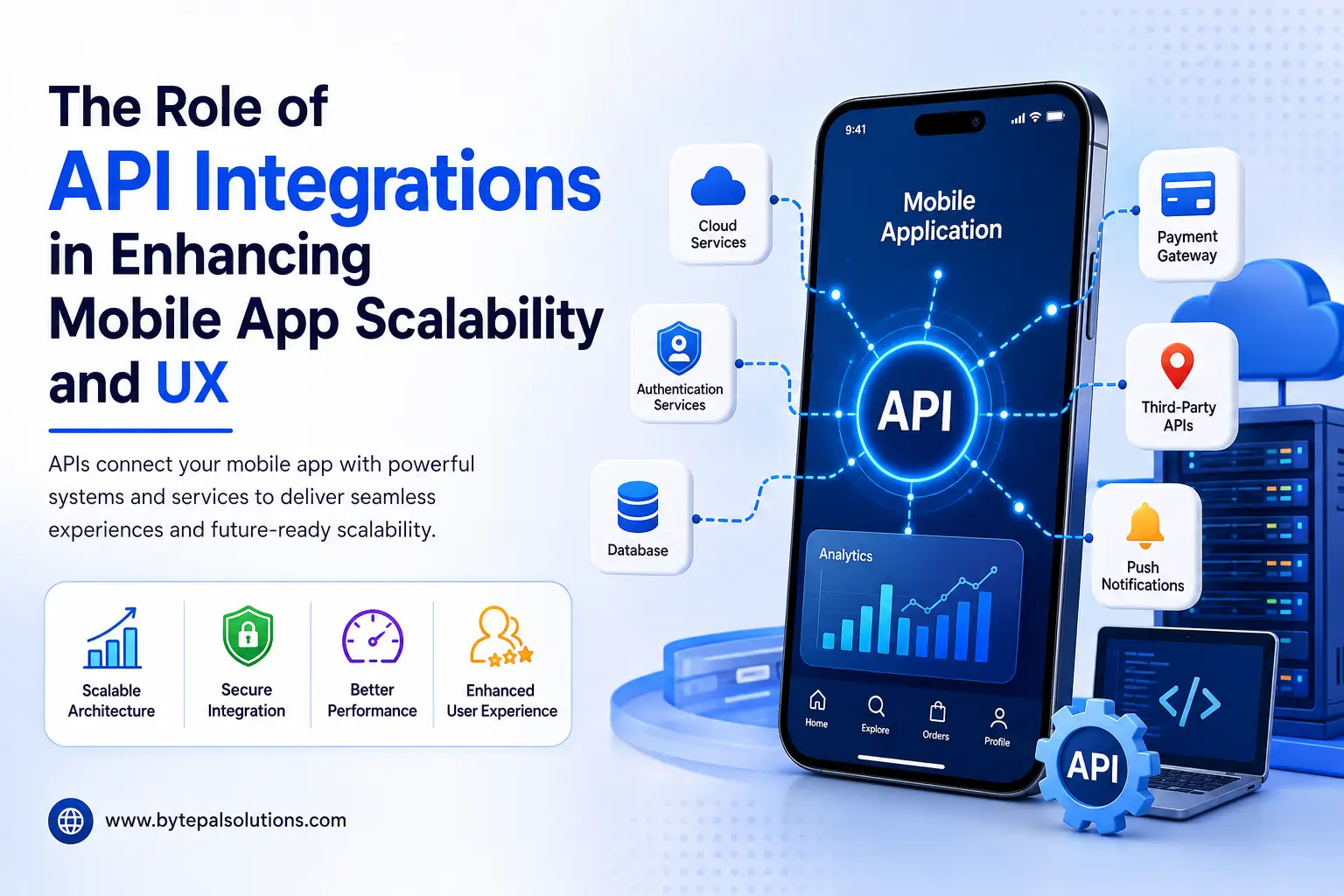
The Role of API Integrations in Enhancing Mobile AppScalability and User Experience (UX)
October 9, 2026 Riya Khare App development What is API Integration in Mobile App Development? An Application Programming Interface (API) is a set of protocols that enables different software applications to communicate securely with one another. Instead of directly accessing databases or backend systems, mobile applications exchange structured requests through APIs. These requests are processed by backend servers, which then return the required information to the application. For example: Logging in with Google Processing online payments Displaying Google Maps Fetching product inventory Synchronizing customer information from CRM software All of these functions rely on API integrations. By using APIs, businesses can connect mobile applications with internal systems and third-party services without rebuilding existing infrastructure. Why API Integration Matters for Modern Mobile Applications Today’s businesses rely on multiple software platforms simultaneously. These often include: Customer Relationship Management (CRM) Enterprise Resource Planning (ERP) Cloud storage Payment gateways SMS services Email platforms Analytics tools AI-powered services API integration connects all these systems into one seamless mobile experience. Without APIs, every new feature would require building an entirely new backend system, significantly increasing development time and operational costs. As businesses continue to embrace digital transformation, API Integration in Mobile App Development has become a fundamental strategy for building connected, scalable, and intelligent applications. Whether you’re integrating payment gateways, CRM platforms, cloud services, or enterprise software, API Integration in Mobile App Development enables seamless communication between systems while improving operational efficiency and delivering a superior user experience. How API Integration Improves Mobile App Scalability One of the biggest advantages of API integration is scalability. As your business grows, your application should be able to support: More users Higher transaction volumes New features Larger databases Multiple devices Global traffic A robust API architecture makes this possible. 1. Microservices Architecture Traditional applications often rely on monolithic architecture where every feature is connected within a single system. If one component experiences heavy traffic, the entire application may slow down. Modern mobile applications use microservices, where individual services operate independently. For example: User Authentication API Payment API Notification API Product Catalog API Order Management API Each service scales independently, improving overall application performance while reducing downtime. 2. Cloud-Based Processing Mobile devices have limited processing power. Instead of handling heavy operations locally, APIs send requests to cloud servers where complex processing occurs. This approach offers several benefits: Faster app performance Lower battery consumption Reduced device storage usage Improved processing speed Better scalability during peak traffic Cloud APIs also allow businesses to increase computing resources whenever demand grows. 3. Intelligent Caching Repeated API requests increase server load. Modern APIs implement caching mechanisms that temporarily store frequently accessed data such as: User profiles Product categories Images Settings Static content This reduces unnecessary server communication while improving application speed. Benefits include: Faster loading times Reduced server costs Lower bandwidth usage Better customer experience 4. Easier Feature Expansion Businesses constantly add new services. Examples include: AI chatbots Push notifications Loyalty programs Video consultations Digital wallets Appointment scheduling With API-driven architecture, developers simply integrate new APIs instead of rebuilding the entire application. This significantly reduces development time. How API Integration Enhances User Experience (UX) User experience goes beyond attractive design. Customers expect applications to respond instantly and work reliably. API integration directly contributes to a better UX in several ways. Real-Time Data Synchronization Users expect accurate information at all times. APIs synchronize data instantly between: Mobile apps Websites Backend systems Cloud databases Examples include: Delivery tracking Banking balances Healthcare records Inventory management Live order updates Real-time synchronization builds customer trust. Faster Login Experience Modern authentication APIs simplify user access through: Google Login Apple Sign-In Microsoft Login Biometric authentication Multi-factor authentication (MFA) These features reduce friction during onboarding while improving account security. Seamless Payment Processing Businesses can integrate secure payment gateways like: Stripe PayPal Razorpay Square Customers enjoy: One-click payments Faster checkout Secure transactions Multiple payment options This leads to higher conversion rates. Offline Functionality Poor internet connectivity should not interrupt business operations. Modern API architecture supports: Local data storage Automatic synchronization Retry mechanisms Background uploads Users can continue working even without internet access. API Integration for Enterprise Mobile Applications Many enterprises still rely on legacy systems developed years ago. These include: ERP software CRM platforms HR systems Inventory software Accounting platforms Replacing these systems is expensive. Instead, businesses use API gateways that connect modern mobile applications with existing infrastructure. Typical API Architecture Mobile Application │ Secure HTTPS Requests │ API Gateway │ ────────────────────────── │ │ Third-Party APIs Legacy Systems │ │ Payment APIs ERP Software Maps API CRM Platform SMS API HR Management Cloud Storage Accounting System │ Business Database The API Gateway acts as a secure communication layer by: Authenticating requests Validating users Transforming data Monitoring traffic Applying security policies This allows businesses to modernize applications without replacing existing enterprise software. Essential API Security Best Practices Security is one of the most important aspects of API integration in mobile app development. Businesses handle sensitive customer information including: Personal data Payment information Healthcare records Business documents Modern APIs protect this information through multiple security layers. OAuth 2.1 Authentication OAuth provides secure user authorization without exposing passwords. Combined with PKCE (Proof Key for Code Exchange), it protects users from token interception attacks. HTTPS & TLS Encryption All API communication should be encrypted using TLS. Encryption prevents hackers from reading intercepted data. Rate Limiting Rate limiting restricts the number of requests a user or device can send. Benefits include: DDoS protection Reduced server overload Prevention of brute-force attacks Token-Based Authentication Instead of storing passwords, modern APIs use secure access tokens. Tokens: Expire automatically Improve security Simplify authentication Reduce unauthorized access Best Practices for Successful API Integration To build scalable and secure mobile applications, businesses should: Design RESTful or GraphQL APIs Keep APIs well documented Use API versioning
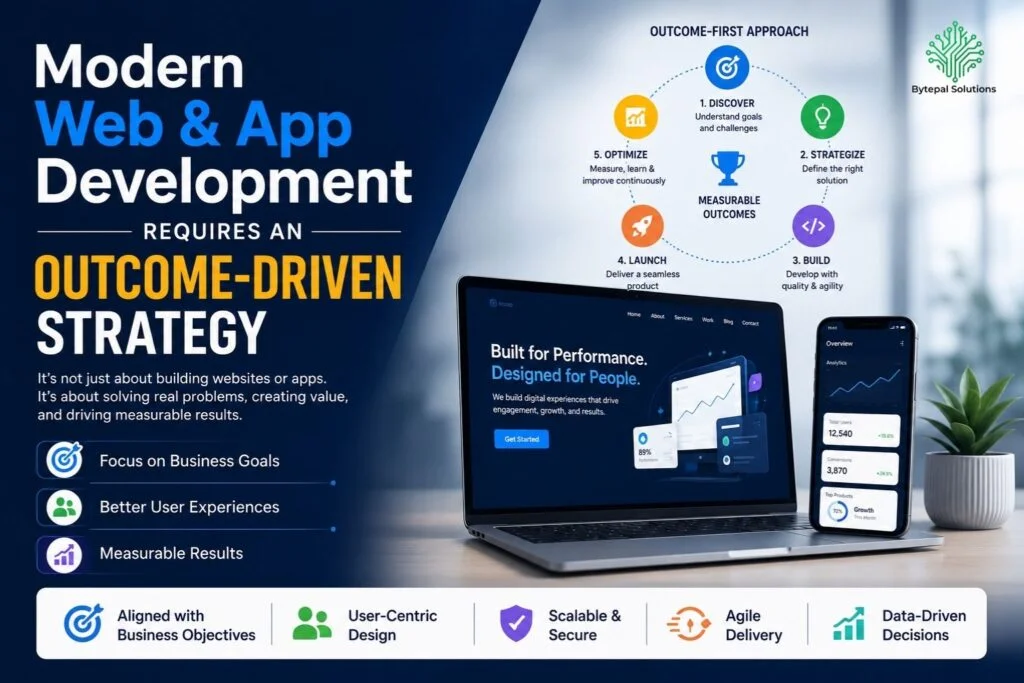
Modern Web & App Development Requires an Outcome-Driven Strategy
October 9, 2026 Riya Khare App development For years, enterprise digital products followed a familiar, linear lifecycle. A business would identify a need, hire an engineering team to write custom code for months, and launch a monolithic application. Then came the endless cycle of expensive maintenance, rigid software upgrades, and mounting technical debt. In today’s fast-moving enterprise environment, that traditional model is a financial bottleneck. Modern web and mobile applications are no longer just software products; they are the core engines driving business revenue, operational efficiency, and customer retention. For executive leadership, the priority has shifted from simply launching a platform to engineering long-term ROI. To stay competitive, forward-thinking organizations are abandoning rigid software architectures in favor of Outcome-Driven Development and Composable Systems. Shifting from Feature-First to Outcome-Driven Engineering The most common point of failure in complex software projects isn’t the code itself—it is a lack of alignment with measurable business outcomes. Teams frequently fall into the trap of prioritizing features over functionality, building complex components before validating their economic or operational utility. An outcome-driven strategy reverses this methodology by anchoring every technical decision to explicit corporate Key Performance Indicators (KPIs). Technical Choices Driven by Business Impact Enterprise Objective Technical Execution Strategy Core Metric Impact Accelerate Time-to-Market Cross-platform consolidation utilizing unified frameworks like Flutter or React Native instead of separate iOS and Android native silos. 30-40% reduction in upfront engineering hours; simultaneous multi-platform release parity. Optimize System Performance Migrating legacy frontend infrastructure to edge-computed environments and utilizing performance-first compilers. Sub-second page loads, stabilized Core Web Vitals (LCP/INP), and direct optimization of organic search visibility. Lower Customer Support Costs Designing predictive user interfaces (UI) and integrating contextual workflow automation directly into the client dashboard. Drastic reduction in customer onboarding duration and a drop in low-tier support ticket creation. The Power of Composable and API-First Architecture Monolithic web and mobile applications—where the user interface, backend logic, and database are permanently bound together—are structurally brittle. When one component requires an update or experiences a traffic spike, the entire system faces downtime risks. To build a resilient digital presence, enterprises are moving toward Composable Architecture.
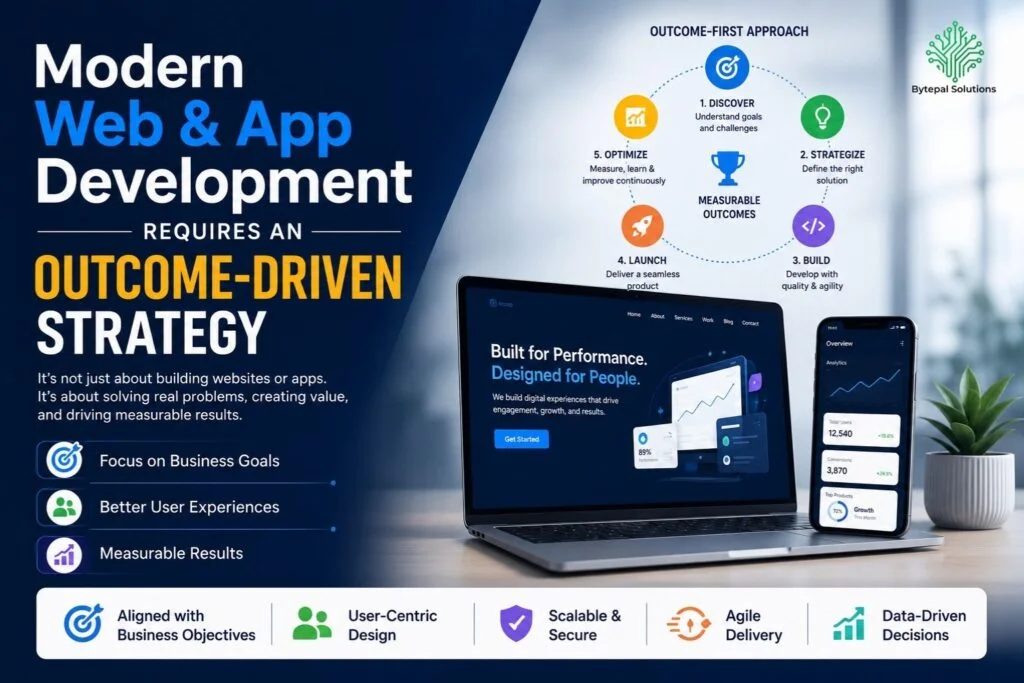
Modern Web & App Development Requires an Outcome-Driven Strategy
For years, enterprise digital products followed a familiar, linear lifecycle. A business would identify a need, hire an engineering team to write custom code for months, and launch a monolithic application. Then came the endless cycle of expensive maintenance, rigid software upgrades, and mounting technical debt. In today’s fast-moving enterprise environment, that traditional model is a financial bottleneck. Modern web and mobile applications are no longer just software products; they are the core engines driving business revenue, operational efficiency, and customer retention. For executive leadership, the priority has shifted from simply launching a platform to engineering long-term ROI. To stay competitive, forward-thinking organizations are abandoning rigid software architectures in favor of Outcome-Driven Development and Composable Systems. Shifting from Feature-First to Outcome-Driven Engineering The most common point of failure in complex software projects isn’t the code itself—it is a lack of alignment with measurable business outcomes. Teams frequently fall into the trap of prioritizing features over functionality, building complex components before validating their economic or operational utility. An outcome-driven strategy reverses this methodology by anchoring every technical decision to explicit corporate Key Performance Indicators (KPIs). Technical Choices Driven by Business Impact Enterprise Objective Technical Execution Strategy Core Metric Impact Accelerate Time-to-Market Cross-platform consolidation utilizing unified frameworks like Flutter or React Native instead of separate iOS and Android native silos. 30-40% reduction in upfront engineering hours; simultaneous multi-platform release parity. Optimize System Performance Migrating legacy frontend infrastructure to edge-computed environments and utilizing performance-first compilers. Sub-second page loads, stabilized Core Web Vitals (LCP/INP), and direct optimization of organic search visibility. Lower Customer Support Costs Designing predictive user interfaces (UI) and integrating contextual workflow automation directly into the client dashboard. Drastic reduction in customer onboarding duration and a drop in low-tier support ticket creation. The Power of Composable and API-First Architecture Monolithic web and mobile applications—where the user interface, backend logic, and database are permanently bound together—are structurally brittle. When one component requires an update or experiences a traffic spike, the entire system faces downtime risks. To build a resilient digital presence, enterprises are moving toward Composable Architecture. [ Headless Frontend: Web / iOS / Android ] │ ▼ (Secure API Layer) ┌─────────────────────────────────────────────────────────┐ │ Decoupled Core Microservices │ │ ┌─────────────────┐ ┌─────────────────┐ ┌───────────┐ │ │ │ Enterprise CRM │ │ Payment Gateway │ │ Custom AI │ │ │ └─────────────────┘ └─────────────────┘ └───────────┘ │ └─────────────────────────────────────────────────────────┘ This modular approach treats software as a collection of independent, interchangeable building blocks connected via secure Application Programming Interfaces (APIs). Decoupled Frontends (Headless Frameworks): By separating your client-facing application from backend databases, you gain the freedom to overhaul your web design or launch a new mobile application without rewriting your core business logic. Seamless Third-Party Ecosystem Integration: An API-first infrastructure allows your software to communicate flawlessly with internal enterprise resource planning (ERP) systems, legacy customer relationship management (CRM) platforms, and custom business intelligence databases. Risk Mitigation and Elastic Scalability: If your payment gateway or a specific data microservice experiences heavy transaction volumes, only that isolated module scales up via cloud-native load balancers—keeping the rest of your application fast, secure, and completely unaffected. Prioritizing Enterprise-Grade Security and Compliance When building web and mobile applications that handle proprietary data, financial transactions, or user metrics, security cannot be treated as a final quality assurance checklist. It must be embedded directly into the continuous integration and deployment (CI/CD) pipeline. Modern engineering frameworks demand a proactive defensive posture: The Baseline of Security: Every digital platform must be engineered with explicit Role-Based Access Control (RBAC), end-to-end data encryption across both transit and rest states, and absolute compliance alignment with regional and industry data privacy mandates. Engineer Your Digital Infrastructure with BytePal Solutions Developing high-impact digital products requires a partner who understands the fine balance between clean code, system security, and long-term business value. At BytePal Solutions, we specialize in architecting scalable, performance-driven web platforms and cross-platform mobile applications. From minimum viable product (MVP) design for market validation to complex enterprise system modernization, our seasoned software engineers build the digital tools that propel your company forward. Antivirus Plans Complete protection for your digital life and identity. Real-time Malware Protection Ransomware & Virus Defense Phishing & Ad Blocking Secure VPN & Privacy Tools STANDARDPLUSTOTAL$49.99Get Protected with Standard → AMC Plans Smart maintenance for your systems. Regular System Health Checks Software Updates & Optimization Remote IT Support Priority Assistance 1 Device2 Devices3 Devices$249.99Get Protected for 1 Device → Digital Solutions WEBSITEMOBILE APP Smart websites for your digital presence and business growth. Responsive Design (Mobile-Friendly) SEO Optimized Structure Fast Loading Speed Secure & Scalable Setup Custom UI/UX Design Easy Content Management $299Get Started with Website →